By Daniel Pereira
Registation for FOE6 is still open. Please join us in a few weeks in Cambridge!
FUTURES OF ENTERTAINMENT 6
Nov. 9-10, 2012
Bartos Theater (Wiesner Building)
Massachusetts Institute of Technology (MIT)
Cambridge, MA
http://convergenceculture.org/futuresofentertainment/2012/
Registration is available here. Also, note there is a pre-conference MIT Communications Forum free and open to the public on Thursday, Nov. 8.
At the two-day conference, each morning will be spent discussing key issues faced by media producers, marketers, and audiences alike, at the heart of the futures of entertainment. Each afternoon, we will look into how some of those issues are manifesting themselves in specific media industries.
More information will be released regularly from @futuresof on Twitter.
Also, in anticipation of FOE6, we are finally archiving the video from FOE5 to the FOE site for archive purposes. Video and links found below.
Futures of Entertainment 5 - The Videos
All the videos from the 2011 Futures of Entertainment Conference can be found at the following link:
http://ttv.mit.edu/collections/convergenceculture/videos
2011 FOE5/MIT CMS Communications Forum Event
Cities and the Future of Entertainment
FUTURES OF ENTERTAINMENT 5 (2011)
Day One:
Introduction
Spreadable Media: Creating Value and Meaning in a Networked Society
Collaboration? Emerging Models for Audiences to Participate in Entertainment Decision-Making
Creating with the Crowd: Crowdsourcing for Funding, Producing and Circulating Media Content
Here We Are Now (Entertain Us): Location, Mobile, and How Data Tells Stories
At What Cost?: The Privacy Issues that Must Be Considered in a Digital World
Day Two:
Introduction
The Futures of Serialized Storytelling
The Futures of Children's Media
The Futures of Nonfiction Storytelling
The Futures of Music
Information on previous conferences can be found here.
http://convergenceculture.org/futuresofentertainment/2011/
By Daniel Pereira
Registation for FOE6 is still open. Please join us in a few weeks in Cambridge!
FUTURES OF ENTERTAINMENT 6
Nov. 9-10, 2012
Bartos Theater (Wiesner Building)
Massachusetts Institute of Technology (MIT)
Cambridge, MA
http://convergenceculture.org/futuresofentertainment/2012/
Registration is available here. Also, note there is a pre-conference MIT Communications Forum free and open to the public on Thursday, Nov. 8.
At the two-day conference, each morning will be spent discussing key issues faced by media producers, marketers, and audiences alike, at the heart of the futures of entertainment. Each afternoon, we will look into how some of those issues are manifesting themselves in specific media industries.
More information will be released regularly from @futuresof on Twitter.
Also, in anticipation of FOE6, we are finally archiving the video from Transmedia Hollywood 3 here at the FOE site. Transmedia Hollywood is our sister event, held annually in the spring at the USC or UCLA campus. A description of Transmedia Hollywood and the videos can be found below.
Transmedia Hollywood 3: Rethinking Creative Relations
As transmedia models become more central to the ways that the entertainment industry operates, the result has been some dramatic shifts within production culture, shifts in the ways labor gets organized, in how productions get financed and distributed, in the relations between media industries, and in the locations from which creative decisions are being made.
This year’s Transmedia, Hollywood examines the ways that transmedia approaches are forcing the media industry to reconsider old production logics and practices, paving the way for new kinds of creative output. Our hope is to capture these transitions by bringing together established players from mainstream media industries and independent producers trying new routes to the market. We also hope to bring a global perspective to the conversation, looking closely at the ways transmedia operates in a range of different creative economies and how these different imperatives result in different understandings of what transmedia can contribute to the storytelling process – for traditional Hollywood, the global media industries, and for all the independent media-makers who are taking up the challenge to reinvent traditional media-making for a “connected” audience of collaborators.
Many of Hollywood’s entrenched business and creative practices remain deeply mired in the past, weighed down by rigid hierarchies, interlocking bureaucracies, and institutionalized gatekeepers (e.g. the corporate executives, agents, managers, and lawyers). In this volatile moment of crisis and opportunity, as Hollywood shifts from an analog to a digital industry, one which embraces collaboration, collectivity, and compelling uses of social media, a number of powerful independent voices have emerged. These include high-profile transmedia production companies such as Jeff Gomez’s Starlight Runner Entertainment as well as less well-funded and well-staffed solo artists who are coming together virtually from various locations across the globe. What these top-down and bottom-up developments have in common is a desire to buck tradition and to help invent the future of entertainment. One of the issues we hope to address today is the social, cultural, and industrial impact of these new forms of international collaboration and mixtures of old and new work cultures.
Another topic is the future of independent film. Will creative commons replace copyright? Will crowdsourcing replace the antiquated foreign sales model? Will the guilds be able to protect the rights of digital laborers who work for peanuts? What about audiences who work for free? Given that most people today spend the bulk of their leisure time online, why aren’t independent artists going online and connecting with their community before committing their hard-earned dollars on a speculative project designed for the smallest group of people imaginable – those that frequent art-house theaters?
Fearing obsolescence in the near future, many of Hollywood’s traditional studios and networks are looking increasingly to outsiders – often from Silicon Valley or Madison Avenue – to teach these old dogs some new tricks. Many current studio and network executives are overseeing in-house agencies, whose names – Sony Interactive Imageworks, NBC Digital, and Disney Interactive Media Group – are meant to describe their cutting-edge activities and differentiate themselves from Hollywood’s old guard.
Creating media in the digital age is “nice work if you can get it,” according to labor scholar Andrew Ross in a recent book of the same name. Frequently situated in park-like “campuses,” many of these new, experimental companies and divisions are hiring large numbers of next generation workers, offering them attractive amenities ranging from coffee bars to well-prepared organic food to basketball courts. However, even though these perks help to humanize the workplace, several labor scholars (e.g. Andrew Ross, Mark Deuze, Rosalind Gill) see them as glittering distractions, obscuring a looming problem on the horizon – a new workforce of “temps, freelancers, adjuncts, and migrants.”
While the analog model still dominates in Hollywood, the digital hand-writing is on the wall; therefore, the labor guilds, lawyers, and agent/managers must intervene to find ways to restore the eroding power/leverage of creators. In addition, shouldn’t the guilds be mindful of the new generation of digital laborers working inside these in-house agencies? What about the creative talent that emerges from Madison Avenue ad agencies like Goodby, Silverstein & Partners, makers of the Asylum 626 first-person horror experience for Doritos; or Grey’s Advertising, makers of the Behind the Still collective campaign for Canon? Google has not only put the networks’ 30-second ad to shame using Adword, but its Creative Labs has taken marketing to new aesthetic heights with its breathtaking Johnny Cash [collective] Project. Furthermore, Google’s evocative Parisian Love campaign reminds us just how intimately intertwined our real and virtual lives have become.
Shouldn’t Hollywood take note that many of its most powerful writers, directors, and producers are starting to embrace transmedia in direct and meaningful ways by inviting artists from the worlds of comic books, gaming, and web design to collaborate? These collaborations enhance the storytelling and aesthetic worlds tenfold, enriching “worlds” as diverse as The Dark Knight, The Avengers, and cable’s The Walking Dead. Hopefully, this conference will leave all of us with a broader understanding of what it means to be a media maker today – by revealing new and expansive ways for artists to collaborate with Hollywood media managers, audiences, advertisers, members of the tech culture, and with one another.
Once the dominant player in the content industry, Hollywood today is having to look as far away as Silicon Valley and Madison Avenue for collaborators in the 2.0 space.
Moderator: Denise Mann, UCLA
Panelists:
Nick Childs, Executive Creative Director, Fleishman Hillard
Jennifer Holt, co-Director, Media Industries Project, UCSB
Lee Hunter, Global Head of Marketing, YouTube
Jordan Levin, CEO, Generate
In countries with strong state support for media production, alternative forms of transmedia are taking shape. How has transmedia fit within the effort of nation-states to promote and expand their creative economies?
Moderator: Laurie Baird, Strategic Consultant – Media and Entertainment at Georgia Tech Institute for People and Technology.
Panelists:
Jesse Albert, Producer & Consultant in Film, Television, Digital Media, Live Events & Branded Content
Morgan Bouchet, Vice-President, Transmedia and Social Media, Content Division, Orange
Christy Dena, Director, Universe Creation 101
Sara DIamond, President, Ontario College of Art and Design University
Mauricio Mota, Chief Storytelling Officer, Co-founder of The Alchemists
A new generation of media makers are taking art out of the rarefied world of crumbling art-house theaters, museums, and galleries and putting it back in the hands of the masses, creating immersive, interactive, and collaborative works of transmedia entertainment, made for and by the people who enjoy it most.
Moderator: Denise Mann, UCLA.
Panelists:
Tara Tiger Brown, Freelance Interactive Producer/Product Manager
Mike Farah, President of Production, Funny Or DIe
Ted Hope, Producer/Partner/Founder, Double Hope Films
Sheila C. Murphy, Associate Professor, University of Michigan
By many accounts, the comics industry is failing. Yet, comics have never played a more central role in the entertainment industry, seeding more and more film and television franchises. What advantages does audience-tested content bring to other media? What do the producers owe to those die-hard fans as they translate comic book mythology to screen? And why have so many TV series expanded their narrative through graphic novels in recent years?
Moderator: Geoffrey Long, Lead Narrative Producer for the Narrative Design Team at Microsoft Studios.
Panelists:
Katherine Keller, Culture Vultures Editrix at Sequential Tart
Joe LeFavi, Quixotic Transmedia
Mike Richardson, President, Dark Horse Comics
Mark Verheiden, Writer (Falling Skies, Heroes)
Mary Vogt, Costume Designer (Rise Of The Silver Surfer, Men In Black)
We are pleased to announce that the Futures of Entertainment 6 conference will be held on Friday, Nov. 9, and Saturday, Nov. 10, at the Bartos Theater on MIT's campus in Cambridge, MA. Registration is available here. Also, note there is a pre-conference MIT Communications Forum free and open to the public on Thursday, Nov. 8. Some details below.
At the two-day conference, each morning will be spent discussing key issues faced by media producers, marketers, and audiences alike, at the heart of "the futures of entertainment." Each afternoon, we will look into how some of those issues are manifesting themselves in specific media industries.
Here is the schedule outline, as well as some of the confirmed panelists who will be joining us at the event. More information will be released regularly from @futuresof on Twitter. We will also have the conference website up later this month.
Thursday, Nov. 8
7:00 p.m.-9:00 p.m.: MIT Communications Forum Pre-FoE6 Event at Building E25 Room 111 New Media in West Africa
Panelists:
Derrick "DNA" Ashong, leader, Soulflége
Colin Maclay, Managing Director, Berkman Center for Internet & Society, Harvard University
Fadzi Makanda, Business Development Manager, iROKO Partners
Moderator: Ralph Simon, head of the Mobilium Advisory Group and a founder of the mobile entertainment industry
Friday, Nov. 9
7:30 a.m. Registration Opens
8:30 a.m.-9:00 a.m.: Opening Remarks from FoE Fellows Laurie Baird and Ana Domb
9:00 a.m.-11:00 a.m.: Listening and Empathy: Making Companies More Human
Panelists:
Lara Lee, Chief Innovation and Operating Officer, Continuum
Grant McCracken, author, Culturematic, Chief Culture Officer
Carol Sanford, author, The Responsible Business
Emily Yellin, author, Your Call Is (Not That) Important to Us
Moderator: Sam Ford, Director of Digital Strategy, Peppercomm
11:00 a.m.-11:30 a.m.: Break
11:30 a.m.-12:30 p.m.: The Ethics and Politics of Curation in a Spreadable Media World--A One-on-One Conversation with Brain Pickings' Maria Popova and Undercurrent's Joshua Green
12:30 p.m.-1:45 p.m.: Lunch Break
1:45 p.m.-3:45 p.m.: The Futures of Public Media
Panelists:
Nolan Bowie, Senior Fellow and Adjunct Lecturer in Public Policy, Kennedy School of Government, Harvard University
Andrew Golis, Director of Digital Media and Senior Editor, FRONTLINE
Rekha Murthy, Director of Projects and Partnerships, Public Radio Exchange
Annika Nyberg Frankenhaeuser, Media Director, European Broadcasting Union
Moderator: Jessica Clark, media strategist, Association of Independents in Radio
3:45 p.m.-4:15 p.m.: Break
4:15 p.m.-6:15 p.m.: From Participatory Culture to Political Participation
Panelists:
Sasha Costanza-Chock, Assistant Professor of Civic Media, MIT
Dorian Electra, performing artist ("I'm in Love with Friedrich Hayek"; "Roll with the Flow")
Lauren Bird, Creative Media Coordinator, Harry Potter Alliance
Aman Ali, co-creator, 30 Mosques in 30 Days
Bassam Tariq, co-creator, 30 Mosques in 30 Days
Moderator: Sangita Shresthova, Research Director of CivicPaths, University of Southern California
6:15 p.m.-6:45 p.m.: Closing Remarks from Maurício Mota and Louisa Stein
Saturday, Nov. 10
7:30 a.m. Registration Opens
8:30 a.m.-9:00 a.m.: Opening Remarks from Xiaochang Li and Mike Monello
9:00 a.m.-11:00 a.m.: Curing the Shiny New Object Syndrome: Strategy Vs. Hype When Using New Technologies
Panelists:
Todd Cunningham, Futures of Entertainment Fellow and television audience research leader
Jason Falls, CEO, Social Media Explorer
Eden Medina, Associate Professor of Informatics and Computing, Indiana University
Mansi Poddar, co-founder, Brown Paper Bag
David Polinchock, Director, AT&T AdWorks Lab
Moderator: Ben Malbon, Managing Director, Google Creative Lab
11:00 a.m.-11:30 a.m.: Break
11:30 a.m.-1:00 p.m.: Rethinking Copyright: A discussion with musician, songwriter, and producer T Bone Burnett; Henry Jenkins, Provost's Professor of Communication, Journalism, Cinematic Arts, and Education at the University of Southern California; and Jonathan Taplin, Director of the Annenberg Innovation Lab at the University of Southern California
1:00 p.m.-2:15 p.m.: Lunch Break
2:15 p.m.-4:15 p.m.: The Futures of Video Gaming
Panelists:
Ed Fries, architect of Microsoft's video game business and co-founder of the Xbox project
T.L. Taylor, Associate Professor of Comparative Media Studies, MIT
Yanis Varoufakis, Economist-in-Residence, Valve Software
Christopher Weaver, founder of Bethesda Softworks and industry liaison, MITGameLab
Moderator: Futures of Entertainment Fellow and games producer Alec Austin
4:15 p.m.-4:45 p.m.: Break
4:45 p.m.-6:45 p.m.: The Futures of Storytelling and Sports
Panelists:
Abe Stein, researcher at Singapore-MIT GAMBIT Game Lab; graduate student, Comparative Media Studies, MIT; columnist, Kill Screen
Peter Stringer, Senior Director of Interactive Media, Boston Celtics
Alex Chisholm, transmedia producer and Co-Founder and Executive Director, Learning Games Network
Moderator: Mark Warshaw, President, The Alchemists Transmedia Storytelling Company
6:45 p.m.-7:15 p.m.: Closing Remarks from Heather Hendershot and Sheila Seles
7:15 p.m.: Post-Conference Workshop--The Futures of Transmedia Studies: Collaborations in and beyond Higher Education
The Futures of Entertainment 6 conference will be held on Friday, Nov. 9, and Saturday, Nov. 10, at the Wong Auditorium on the campus of MIT. Registration, including a list of the panel topics, is open here. More information to come in the next few weeks on the programming.
By Daniel Pereira
Register now for Transmedia Hollywood, April 6, USC.
2011 C3 Research Memos and White Paper Series
edited by Prof. Henry Jenkins, Prof. William Uricchio
and Daniel Pereira
Now available on the FOE website:
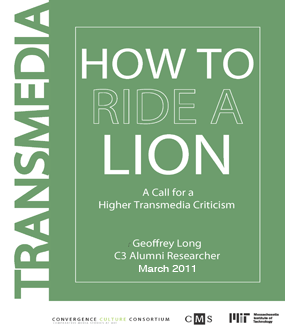
How to Ride a Lion: A Call for a Higher Transmedia Criticism
A C3 White Paper by
Geoffrey Long
Futures of Entertainment Fellow
Alumni Researcher for the Convergence Culture Consortium (C3)
Download the executive summary or the entire research memo.
(Author's Note: Since this paper was originally authored in 2010, I've been delighted to discover an increasing amount of transmedia critics. Whose analysis of transmedia projects do you most enjoy? Please let us know in the comments! -GL)
PART 3 of 3
4. Conclusions and Next Steps
By now, the value proposition for transmedia criticism should be clear, even if the challenges involved in developing it are daunting. Even if one believes (as I do) that the rewards do justify the labor involved, the question remains of where such criticism will be found. Who will these transmedia critics be, and where will they publish their work?
It's easier to imagine a home for transmedia criticism than one for transmedia reviews. Academically speaking, an easy place to begin would be a Journal of Transmedia Studies, but so far that has yet to come into existence. As more conferences and academic programs begin to appear with transmedia as their focus, more critical thinking about transmedia projects will continue to be produced as a result, and will likely be released either as conference proceedings or on blogs dedicated to particular courses or research projects (not unlike the C3 blog in its heyday)[18]. Programs to keep an eye on for such resources include the MIT Comparative Media Studies program, the IMAP program at USC, the Center for Future Storytelling at the MIT Media Lab, and the nascent Center for Serious Play at the University of Washington.
To date, many discussions of transmedia projects at levels that begin to approach true transmedia criticism can be found around the burgeoning alternate reality game sub-industry, such as ARGNet, the mailing list for the IGDA ARG SIG (or the International Game Developers' Association Alternate Reality Game Special Interest Group, for the uninitiated) or the blogs of ARG authors like Andrea Phillips, whose April 6, 2010 post analyzing the Why So Serious ARG campaign for The Dark Knight explained what that campaign did exceptionally well and, in so doing, showed why the first Twilight book is so poorly designed for transmedia extension. Phillips:
One: Experiences like Why So Serious have come under criticism because they arguably don't create audiences where none were before. At the end of the day, the people who were really involved in Why So Serious were all people who were going to see the movie anyway, right? It's uncomfortable to admit it in public like this, but... yeah, it's probably true.
Two: The most successful transmedia experiences are the ones where there is space for the player to live in the world. Harry Potter, Star Wars, Lord of the Rings; these are all worlds that are very much bigger than the action on the main stage. And that's what we do in the ARG space; we provide walk-on roles that let people live in our worlds, while not requiring them to step onto the main stage themselves.
That's why the first Twilight book is poorly suited to transmedia; there isn't much of a world there outside of the couple in love. But the subsequent books increase the scope of the world more and more, incorporating group dynamics and government structures that add up to a world bigger than just Bella and Edward and their true, sparkly love.
So why was Why So Serious such a big deal? It's because it took a world that did not have space for an audience to live inside it - Gotham - and created canon spaces where players could dwell, for the first time. They became voters and accomplices. It turned a property that was previously not very well suited to a transmedia experience and created one that suddenly is. It's not just Batman and his allies and enemies anymore.
And while the people participating in that world are probably the ones who loved the property before, all of that energy and excitement brings more people in. The person with the Joker mask was already going to see the movie, but maybe their roommate wasn't going to, or their cousin, or the person they enthuse about the film to at work or at the coffee shop or on the bus.
I know I started reading Harry Potter because of all of the fan energy around it; that's also why I read Twilight. Giving your audience the freedom and an outlet for their passion for your work leads to them converting peripheral audience members into fans, and people who were never a part of the core audience into peripheral audience members. Participation is the engine that drives fandom, and fandom drives success.
So there you have it, one of the most important keys to making a great transmedia world: Scope. Make it roomy enough for your audience to play in your world. They'll love you for it, and their love brings rewards.[19]
I read that post and heaved a sigh of contented relief, as if I'd just been given a tubful of water after marching across the Sahara. It's not long, but it's insightful, and is an excellent example of how some sample transmedia criticism might work: pick a transmedia project to criticize, break it apart to determine what worked and what didn't, bubble up the learnable observations, and draw connections from that observation to other examples to give it context (and your argument more weight). To my mind, this was a brilliant example of nascent transmedia criticism, and I constantly go back to Phillips' site in hopes of finding more.
Another up-and-coming source for transmedia criticism is Christy Dena's cheekily-named You Suck at Transmedia (www.yousuckattransmedia.com), which includes comments from Comparative Media Studies and C3 alumnus Ilya Vedrashko and friend of C3 Jeff Watson. Although the site is relatively sparse (24 posts over six months), many of the articles to be found there are really interesting. Here's an excerpt from Dena's opening post:
You Suck at Transmedia!!
Yes, this is something many of us have been wanting to say for a while...to others (mostly) and to ourselves (sometimes).
But don't worry, this site isn't about trashing specific people or projects. I'm a practitioner too, and so I know how even though we learn quickly, we cringe at old mistakes. But importantly, I also know how bad design is often the result of processes and people you don't have control over. You know it sucks but nobody listened, or believed you, or worse still...you didn't tell them. This site is part of that conversation. Encouraging us all to feel confident about what we know (and find out) sucks.
... How do you/we/us stop sucking at transmedia? Well, this site is a step in that direction. This site welcomes contributions that really do aim to progress the state of the art. Here we can discuss the consequences of transmedia design, production and execution decisions.
In short, this site will cover transmedia decisions that never, sometimes, and always work.[20]
As of this writing, Dena's posts have titles like "YSA Directing Meaning Across Media," "YSA Being an Artist", "YSA Being Human," and "YSA Sucking".[21] As of this writing, most of Dena's posts haven't been critical evaluations of particular transmedia experiences so much as reflections on the trials and tribulations of life as a transmedia experience designer, including videos of Quentin Tarantino talking about being an artist and a critique of the National Theatre's recent mishandling of a Twitter snafu, but the site has a great deal of promise.
A third newly-released resource for transmedia criticism is The Pixel Report, from Power to the Pixel's Liz Rosenthal and Tishna Molla. TPR declares itself to be "devoted to showcasing new forms of storytelling, film-making and cross-media business development that is in tune with an audience-centered digital era. It is an essential tool for content creators, a vital resource for policy-makers & funding bodies and a unique guide for anyone interested in the future of film and the media."[22] Unfortunately, the site seems to be a thinly-veiled set of hooks to draw people to the Power to the Pixel conference or order the proceeds from the conference. Although the site ostensibly includes case studies of such projects as beActive Entertainment's Final Punishment, Tommy Palotta's Collapsus, and the National Film Board of Canada's Waterlife, the site's pages for these case studies amount to little more than an overview of each project, video clips of people discussing these projects from the previous conference, and a big button encouraging people to order the case studies. This feels less like transmedia criticism and more like advertising for Power to the Pixel and their consulting services.
Finding a home for transmedia reviews are much more challenging. Let us for a moment ignore the (very real) possibility that the entire print magazine world is going belly-up. So far most articles on transmedia have been either mile-high "What is Transmedia?" articles in publications like Wired or slightly deeper and more directed pieces in publications dedicated solely to one medium, such as those found in Filmmaker Magazine. Although book reviews, film reviews, music reviews, video game reviews and even technology reviews are commonplace in mainstream publications, is it realistic to expect the New York Times to employ a transmedia critic alongside their film and book critics? How likely is a New York Review of Transmedia, or an On the Transmedia show on NPR?
It's possible that the very structure of transmedia experiences, where ideally each extension in each medium is of sufficient quality and modularity to serve as an ambassador for the rest of the franchise to the 'native' fans of that medium, also extends to critics. If Escape from Butcher Bay is good enough to garner a high score on Metacritic, perhaps it's good enough to be reviewed by video game critics who will serve as multipliers (to steal a term from Grant McCracken) and advocates for the rest of the franchise to their audience. However, this still leaves us wanting for critics who will advocate for transmedia experiences that do transmedia well, evaluating and recommending the "greater than the sum of its parts" super-experience of the franchise as a whole. It's possible that such reviews will be relegated to the review sections for the medium in which each franchise has its mothership - so reviews of the transmedia franchise surrounding The Matrix will be found in the film section, reviews of the transmedia franchise for Assassin's Creed will be in the video game section, and so on - but as transmedia experiences continue to evolve into massive things that touch on every part of our lives, will the notion of "mothership" continue to exist? Only time will tell - but it seems likely that, if such a scenario comes to pass, by that time our reviews systems will have evolved to accommodate such vast experiences as well.
Finally, returning to the notion that newspapers, magazines and other print-centric media structures might be dead anyway, it's possible that the very notion of curated collections of reviews will dissipate as well. We already have big blogs dedicated to particular audience demographics, like Engadget or io9 or Blastr, that, like special-interest basic cable channels, cover everything that might be of interest to that particular demographic.[23] This suggests that students interested in becoming transmedia critics might first attempt to become staff writers for such blogs - and supplement their writings there with a constant stream of insights posted to their own blogs (a tactic similar to that of both Phillips and Dena).
As transmedia continues to trend towards mainstream acceptance and continues to gather mass as a key area of development in the entertainment industry, all of these options are likely to flourish. It's only a matter of time before a Journal of Transmedia Studies appears to support the research coming out of these new academic programs, only a matter of time before sites like io9 have to figure out how to review projects from transmedia shops like Fourth Wall Studios, Quixotic Transmedia, Campfire, or Blacklight Transmedia, and only a matter of time before more rich resources begin to appear online that cater specifically to producers and fans of transmedia experiences.
Our next steps now are for more of us to start engaging in close analyses of transmedia experiences, to start breaking them down and figuring out why they work or why they fail. More of this exploration must be done in order to help us understand how to really leverage the unique affordances of transmedia experience design as its own particular art, both individually and as a whole. Tearing into these new transmedia experiences to figure out what makes them tick, sharing those insights with one another and then using those lessons to create more astonishingly fantastic transmedia experiences, teaching each other how to ride these lions, is how we will push the medium forward. Writing more transmedia reviews to spread the word about those experiences to a broader audience is how we will ensure that we will all keep riding lions for a long time to come.
Geoffrey Long is a media analyst, scholar, and author exploring transmedia experiences and emerging entertainment platforms at Microsoft. Geoffrey received his Master's degree from the Program in Comparative Media Studies at MIT, where he served as a media analyst for the Convergence Culture Consortium and a researcher for the Singapore-MIT GAMBIT Game Lab. Through his work with the Convergence Culture Consortium, Geoffrey authored "How to Ride a Lion: A Call for a Higher Transmedia Criticism" and "Moving Stories: Aesthetics and Production in Mobile Media". His personal site is at geoffreylong.com, he can be reached at glong@geoffreylong.com, and he can be found on Twitter as @geoffreylong.
WORKS CITED:
[18] The Convergence Culture Blog ran from 2005 through 2011.
[19] http://www.deusexmachinatio.com/2010/04/why-so-serious-lessons-in-transmedia-worldbuilding.html
[20] http://www.yousuckattransmedia.com/2010/06/hello-world/
[21] The YSA stands for "You Suck At," naturally.
[22] http://thepixelreport.org/
[23] Unsurprisingly, Blastr.com is operated by genre cable channel Syfy.
BIBLIOGRAPHY:
Bloom, David. "A Critical Shortfall: Who Rates the Transmedia?" TheWrap.com, March 21, 2010. http://www.thewrap.com/television/blog-post/critical-shortfall-who-rates-transmedia-15492
Bordwell, David, Janet Staiger and Kristin Thompson. The Classical Hollywood Cinema: Film Style and Mode of Production to 1960. New York: Columbia University Press, 1985.
Corrigan, Timothy. A Short Guide to Writing About Film, 7th Ed. Longman, 2010.
Delaney, Samuel. Shorter Views.Wesleyan, 2000. [GL10]
Dena, Christy. "Transmedia Practice: Theorising the Practice of Expressing a Fictional World across Distinct Media and Environments." PhD Dissertation. University of Sydney, 2009.
Eagleton, Terry. The Function of Criticism. New York: Verso Press, 2000 ed.
Heer, Jeet and Kent Worcester. Arguing Comics: Literary Masters on a Popular Medium. University Press of Mississippi, 2004.
Ito, Mimi. "Intertextual Enterprises: Writing Alternative Places and Meanings in the Media Mixed Networks of Yugioh." http://www.itofisher.com/mito/archives/ito.intertextual.pdf
Jenkins, Henry. "Revenge of the Origami Unicorn." http://henryjenkins.org/2009/12/the_revenge_of_the_origami_uni.html
Johnson, Derek. "Learning to Share: The Relational Logistics of Media Franchising,"
MIT Comparative Media Studies, Converegence Culture Consortium White Paper,
http://www.convergenceculture.org/research/c3-learningshare-full.pdf
Kochalka, James. The Cute Manifesto. Gainesville: Alternative Comics, 2005.
Long, Geoffrey. "Transmedia Storytelling: Business, Aesthetics and Production at the Jim Henson Company," MIT Comparative Media Studies Master's Thesis, http://cms.mit.edu/research/theses/GeoffreyLong2007.pdf.
Philips, Andrea. "Why So Serious: Lessons in Transmedia Worldbuilding." Deus Ex Machinatio, April 6, 2010. http://www.deusexmachinatio.com/2010/04/why-so-serious-lessons-in-transmedia-worldbuilding.html
Rosenbaum, Jonathan. Essential Cinema: On the Necessity of Film Canons. Baltimore: Johns Hopkins University Press, 2004.
Rosenbaum, Jonathan. Goodbye Cinema, Hello Cinephelia: Film Culture in Transition. Chicago: University of Chicago Press, 2010.
Rosenbaum, Jonathan. Placing Movies: The Practice of Film Criticism. Los Angeles: University of California Press, 1995.
Schwartz, Ben. The Best American Comics Criticism. Seattle: Fantagraphics Books, 2010.
Thompson, Brooke. "A Criticism on the Lack of Criticism." GiantMice.com, June 1, 2010. http://www.giantmice.com/archives/2010/06/a-criticism-on-the-lack-of-criticism/
Wolk, Douglas. Reading Comics: How Graphic Novels Work and What They Mean. Cambridge: Da Capo Press, 2007.
By Daniel Pereira
Register now for Transmedia Hollywood, April 6, USC.
2011 C3 Research Memos and White Paper Series
edited by Prof. Henry Jenkins, Prof. William Uricchio
and Daniel Pereira
Now available on the FOE website:
How to Ride a Lion: A Call for a Higher Transmedia Criticism
A C3 White Paper by
Geoffrey Long
Futures of Entertainment Fellow
Alumni Researcher for the Convergence Culture Consortium (C3)
Download the executive summary or the entire research memo.
(Author's Note: Since this paper was originally authored in 2010, I've been delighted to discover an increasing amount of transmedia critics. Whose analysis of transmedia projects do you most enjoy? Please let us know in the comments! -GL)
PART 2 of 3
3. What Role Might Transmedia Criticism and Reviews Play?
If, as suggested in the last section, what is needed is an ecosystem that includes both transmedia criticism and transmedia reviews, then we need to explore both halves. First, what value can transmedia criticism and transmedia critics provide to the industry? Second, what value can transmedia reviews and reviewers provide to the public?
3.1. Educating the Industry: Transmedia Criticism and Critics
As David Bloom suggested in his 2010 Transmedia /Hollywood recap, transmedia criticism could provide some answers to the very real concerns of the entertainment industry - not just "What is transmedia?" or "Why should I invest in a transmedia project?", but "What does real, measurable success for a transmedia project look like?" Transmedia criticism may not have all the answers - as noted, we desperately need better systems for transmedia 'ratings' and other metrics - but it may provide a jumping-off point for some qualitative analyses while we're waiting for the quantitative ones to catch up.
Most beneficial, perhaps, is the role that such criticism can play in the shaping of a language of transmedia experiences, through the discovery of a set of standard best practices. By understanding these best practices - by speaking the language - creators and their sponsors can improve their chances of creating successful transmedia experiences. Once such an 'open' language is developed, individual implementations of, and strategic differentiations from, those best practices can result in highly profitable products and even new competitive advantages.
In their seminal text The Classical Hollywood Cinema: Film Style and Mode of Production to 1960, David Bordwell, Janet Staiger and Kristin Thompson describe the importance of standardization in the very early years of the cinema. Rather than reinventing the wheel with every film, Hollywood began to adopt standard techniques, formats, and practices that could be reused effectively in each production - which in turn led to a set of norms against which excellence could be judged:
Industrial standardization included uniformity in nomenclature and dimensions, simplification in types, sizes and grades, and safety provisions and rules of practice. Such standardization facilitated mass production. Standardization also included specifications, methods of testing quality, and ratings under specific conditions. The latter set of elements in standardization have another connotation: a criterion, norm, degree or level of excellence. Both the movement toward uniformity and attainment of excellence coexisted in the trend. The standardization process must be thought of not as an inevitable progression towards dull, mediocre products (although many may be that for reasons of aesthetic differences or economy in materials and workmanship), but instead, particularly in competitive cases, as an attempt to achieve a precision-tooled, quality object. Once established, the standard becomes a goal to be attained.[9]
Such desirable characteristics included "narrative dominance and clarity, verisimilitude, continuity, stars and spectacle". Those of us in the transmedia space should be feeling a slight tingling of recognition at this point. Such a key set of standard, recurring elements in transmedia is already beginning to emerge, as outlined in Henry Jenkins' keynote talk at C3's Futures of Entertainment 4 conference, "Revenge of the Origami Unicorn." Jenkins outlined seven principles of transmedia storytelling: spreadability vs. drillability, continuity vs. multiplicity, immersion vs. extractability, worldbuilding, seriality, subjectivity, and performance.[10] Jenkins' observed principles emerged from his close analysis of multiple transmedia experiences, including The Matrix, the Studio Ghibli Museum in Tokyo, Tori Amos' Comic Book Tattoo project, the success of Susan Boyle, American Idol and so on. Such close readings provide the raw fodder for his high-level observations, which are then shared with the public and the industry alike through books, articles, lectures or blog posts. The same kind of standards-from-observation practices from theorists and critics like Jenkins was at play during the early days of cinema. Again, Bordwell et.al.:
Mechanisms for standardization included ones somewhat connected to the industry - trade publications and critics and 'how-to' books - and ones external to the industry - college courses, newspaper reviewing, theoretical writing, and museum exhibitions. Undoubtedly there are others, but these will suggest how standards were available to influence the company's and worker's conception of how the motion picture ought to look and sound. While these mechanisms presented themselves as educational and informative, they were also prescriptive. A how-to-write-a-movie-script book advised not only how it was done but how it ought to be done to insure a sale. In the case of reviewers or theorists, the references to established standards in other arts (theater, literature, painting, design, music, still photography) perpetuated ideological/signifying practices - although, of course, in mediated form.[11]
Bordwell points out that trade papers in the entertainment field (such as the New York Dramatic Mirror, Show World, the New York Clipper, Moving Picture World, Motion Picture News, The Nickelodeon and, of course, Variety) served as an important channel for these theorists and critics to influence their audiences. One such important influential was Epes Winthrop Sargent, a columnist for Moving Picture World:
Sargent began as a critic for music, theater and vaudeville in the 1890s and had been a scenario editor and press agent for Lubin before he arrived at the Moving Picture World in 1911. At that point he began a series of columns, the "Technique of the photoplay," which included formats of scenarios and film production information primarily aimed at the freelance writer and the manufacturers' scenario departments. Those columns appeared in book form in 1912 and in an extensively revised edition in 1913. Although other handbooks of film practice preceded his, Sargent's work became a classic in a field that from that point on rapidly expanded.[12]
Bordwell goes on to quote an article of Sargent's from December of 1909 as a sample of such prescriptive writing, generated from Sargent's observation of emerging best practices in the form and, amusingly, what sounds an awful lot like comparative media studies:
The stories must have situations plainly visible, a clearly drafted story, and, with it, an opportunity for artistic interpretation. Dramatically, a motion picture story must be more intense in its situations than the spoken drama. It is often dragged into inconsistency but this is pardonable if the story is sufficiently strong to warrant it. The point of situation cannot be too strongly emphasized.
...We are told by our masters in short story writing and in drama writing that we must have one theme and one theme only. Too many characters will spoil the spell that grips us when we have but two or three people to watch. We are told to avoid rambling into green hedges off the roadside and to grip the attention of the audience from the very start. The complications should start immediately and the developments come with the proper regard for sequence.
...The period of action in a motion picture play is not restricted although it is best to follow the arrangement as depicted in the vaudeville drama. A single episode or incident which might occur within the length of time it takes to run the film is better than dragging the tale through twenty or thirty years. Too many notes and subtitles interrupt the story and detract from the interest.
...A motion picture play should be consistent and the nearer to real life we get the more is the picture appreciated. Complications which are too easily cleared up make the story unsatisfying, smacking of unreality, thus destroying the illusion that, as the producer faithfully endeavors to portray, the scene is not one of acting, but that we have an inside view of the comedy or tragedy of a real life. Let your stories, though they be strong in plot, be convincing, the situations not merely possible but probable. The producer will then have no trouble in making his actors appear to be real.[13]
If Jenkins chose to do so, he could write a trade column or a book specifically on how to apply his seven principles to transmedia storytelling, replicating the role of Sargent to this newly-emerging field. Close reading and analysis reveals learnable lessons, as any artist will attest; all authors, filmmakers, video game designers and other creative professionals spend years soaking up as much high-quality work in their medium as possible and tearing it apart to see what makes it tick.
Theorists and critics do the same, but they then write up their analyses and share it with others. In doing so, they begin to create a shared language with which to discuss these emerging best practices, which then becomes a linguistic shorthand for particular approaches and tactics, which then in turn becomes a shared lens for understanding how these things work. This is where terms like first person point of view, suspension of disbelief, unreliable narrator and so on come from - and, once those observations and tactics are internalized, they become accepted as tools by a wider creative audience. Once these concepts become tools, they become more commonly used in the creation of future experiences, thus reinforcing the acceptance of the concepts. Criticism becomes influential through dispersion, acceptance and implementation.
Jenkins' ideas are already becoming widely accepted in the industry and his terms are becoming the terminology for this emerging space. The problem is we need much more of this type of work, and we need it quickly. Increase the number of really insightful, clearly-spoken and practically-minded theorist-critics and we accelerate the rate at which we come to understand what transmedia is really capable of. Again, to paraphrase Kochalka, "Transmedia criticism is a means we have of making sense of this new medium, focusing to make it clearer."
The value in adopting the best practices that emerge through such transmedia criticism in order to increase a transmedia experience's chances for success is apparent. However, there's another key reason why an ecosystem of transmedia criticism would be incredibly useful to practitioners: the creation of strategic differentiation. In other words, to see where to zig when everyone else has chosen to zag. As Bordwell writes:
The emphasis on uniformity does not mean that a standard will not change in small ways. New technology, new products and new models are continually put forth as alternative standards for the field. One analyst of standardization wrote: 'An innovation is successful only when it has become a new standard.' That process is dynamic, with multiple practices creating the change. In fact, for the film industry, changing its product was an economic necessity. In the entertainment field, innovations in standards are also prized qualities. The economic reason is that the promotion of the difference between products is a competitive method and encourages repeated consumption. The phrase differentiation of the product is used to describe the practice in which the firm stresses how its goods or services differ from other ones.[14]
Much the same thing can be said for observing best practices in transmedia storytelling. By observing emerging norms for the medium particularly adventuresome, innovative storytellers can choose to do things differently in hopes of achieving strategic differentiation. Revisit Jenkins' list of principles and imagine how they might be flipped on their heads in a narrative experience, resulting in a new and engaging type of transmedia story. As more transmedia criticism emerges, more crazy "what-if" ideas will be sparked, and even more experimental experiences will appear on the market. Those that work spectacularly well - think 3-D in James Cameron's Avatar - will become more broadly adopted, pushing the cycle of significant differentiation into another iteration, and the medium will continue to grow as a result.
Between a shared language for transmedia experience design, a collection of best practices that will increase a transmedia experience's chances of success, and a seedbed for accelerated strategic differentiation, the value of transmedia criticism to practitioners seems clear. However, transmedia experiences without audiences remain difficult to justify. This is where transmedia reviews come into play.
3.2. Educating the Public: Transmedia Reviews and Reviewers
...The way I experience and think about comics has a lot to do with the fact that I really enjoy them. I like figuring out how that pleasure works and describing it to other people so that they can enjoy them too, or at least enjoy them more fully than they would otherwise. And what I like (and want to pass along) about a particular comic can be the pleasure of pure spectacle, or of ingenious design, or of kinetic flow, or of characters' psychological depth, or of a story that's funny or engaging, or any number of other things. (Wolk 21-22)
Massive entertainment franchises - think long-running soap operas or comic books - frequently get a bad rap for being huge, intimidating monsters. Try picking up a random issue of X-Men or turning on a random episode of As The World Turns and figure out what's going on. It's important not to ignore the word 'complex' in 'complex narratives' or 'complex entertainment', and even more important to remember that transmedia entertainment serves as an exponential multiplier to that complexity. Yes, a transmedia franchise that spans comics, television, films and games can have each of its components serve as a gateway into the entire franchise for "native" fans of those particular media, but an Everest like Star Wars or Halo is a massive undertaking looming on a newcomer's horizon. Such franchises aren't just increasingly complex; they're also increasingly time-consuming and increasingly expensive. You think it's difficult deciding which movie is worth your twenty bucks and two hours on Friday night?
As of this writing, buying the canonical Buffyverse on Amazon will set you back over $400, and take weeks to consume. One can only imagine what it would cost in both time and money to experience every film, book, comic, video game, TV show and piece of ancillary merchandise that makes up Star Wars.
This is where a transmedia critic can play sherpa: a really good (there's that word again) transmedia critic can give an interested fan-in-the-making maps to these daunting territories, even suggesting which paths they should take depending on their personal interests. Are they fans of Luke Skywalker? Watch the original movies, read these books, play those games. Fans of space battles? Watch these TV episodes, read these different books, play these other games. A single transmedia critic can't create personalized recommendations for everybody, but that's why we need an entire thriving community of transmedia critics sharing their opinions and providing maps like these.
The people who currently play these roles are the die-hard fans on fan websites, the people who live and breathe these franchises. Unfortunately, they're frequently not the best ambassadors to the series. We need the John Clutes, the Pauline Kaels, the Gene Siskels and Roger Eberts, the people who can analyze and report back on multiple franchises to convince hesitant audiences that these heights really are navigable, that the best experiences really are worth the labor, and that, alas, some of the peaks are actually best avoided. Having multiple transmedia critics, and having those critics establish themselves as experts with distinct tastes across franchises instead of fanboys for particular franchises, will help make such massive, complex entertainments less intimidating - and thus more enticing to mass audiences. And if we're serious about moving transmedia entertainment more and more towards the mainstream, this has got to happen.
Unfortunately, the viability of transmedia reviews - and, for that matter, transmedia criticism - suffers from the same Everest-level challenge. In a June 1, 2010 post to her blog called "A Criticism on the Lack of Criticism", transmedia designer Brooke Thompson puts her finger on one of the biggest problems facing transmedia criticism - scale:
There are a number of challenges to writing critiques on projects, not the least of which is their complexity and length. It's difficult to be critical once you've invested so much time and energy into a project - whether you've designed it or experienced it. Being critical seems harsh and, well, it might make you wonder if you've wasted a bunch of your time and who wants to think that? This is one reason why we may never have a Roger Ebert or Ben Croshaw - the commitment required to fully experience a transmedia project, especially one as complex as an ARG, is far greater than the commitment required for films and video games (or books or music or or or). To make transmedia critique a commitment on that level is difficult and, well, would require far more time than would be profitable. Which makes it a pursuit of passion or, perhaps, an academic exercise. Yet both of these color the criticism, that's not necessarily bad, but in collaborative transmedia that ignores the "other side of the curtain."
In the Comics Journal article "A Call for Higher Criticism" I cited earlier, Paul Levitz suggests that comics critics consider each issue in the context of the larger body of work, that "the time and effort we now devote to carving up a story should be devoted to carving up the universe in which the story exists" (44). This resonates with transmedia reviews, because, as Thompson points out, current reviews of transmedia franchises are usually limited to individual components - so a review of the latest Star Wars video game, instead of a review of Star Wars as an entire franchise.
Thompson hits the nail on the head when she writes, "the commitment required to fully experience a transmedia project... makes it a pursuit of passion or, perhaps, an academic exercise." Being able to review Star Wars, Star Trek, Halo, or any of these other transmedia super-franchises at the franchise level requires thousands of hours to consume it, let alone analyze it and write intelligently about one's findings. In a way, each of these super-franchises is in effect a lifestyle brand - and therein lies both a primary trouble with transmedia reviews, and why they're so important. Imagine you're trying to decide whether to engage with the Star Wars franchise for the first time. The sheer size of the franchise at this point is epic and must loom large in the eye of the potential audience member - again, an Everest on the horizon. This is why Marvel keeps launching new X-Men titles, reboots and alternate versions, attempting to give people an "accessible" version of the X-Men franchise. As Sam Ford writes frequently on the challenges facing new audiences to soap operas, longevity and drillability can be simultaneously a franchise's greatest strength and greatest liability.
Further, there's a chicken-and-egg issue at hand with massive franchises and geekiness: are geeky people attracted to excessively drillable subjects, or does excessive drilling make one geeky? It's just as easy to become a sports geek as it is to become a comic book geek. The catch is that sometimes those people who are the most familiar with the topic, the ones who have done the most drilling, are also those who are the least valuable as the topic's advocates.
From the outside looking in, there must clearly something interesting about Star Wars, soap operas, the Chicago Cubs, quantum physics, the Civil War, and so on, because so many people are so passionately interested in these topics. An outsider may want to engage with the complex topic enough to enjoy it without becoming "that guy", at least until their interest reaches a sufficient level that they crest the tipping point and mastery of the topic becomes acutely desirable. In a way, transmedia reviews, or transmedia criticism for the masses,[15] should be the equivalent of a 101-level course - sufficient to introduce a lay audience to the highlights of a topic, loaded with directions on where to go next for further drilling, and so on. The trouble is that we need, as Thompson points out, a Roger Ebert of transmedia reviews providing a reliable viewpoint to bear on a new franchise every week, which is the equivalent of a rockstar professor teaching an entire Philosophy 101 course one week, a Political Science 101 course the next week, and a History 101 course the week after that.
As Jenkins has pondered for years, there's a strange line to consider between fandom and scholarship - one needs a certain amount of fandom to motivate the epic amount of drilling required to become an expert in a subject, yet one must also remain sufficiently detached to retain an objective perspective. An Ebert who gave a huge thumbs-up to everything he reviewed wouldn't be a very good critic, he'd just be a guy who never shut up about all the things of which he was a fan. A truly valuable transmedia reviewer/critic must be able to engage with multiple massive transmedia franchises and have enough dedication to consume, analyze and report on each of them on a regular basis, even those he or she doesn't like.
Of all the responses to Paul Levitz' call for higher criticism published by The Comics Journal, my favorite is one by Richard Howell and Carol Kalish. Their response contains a brilliant concise definition of what comics criticism should be, which can easily be applied to transmedia criticism as well:
We feel, however, that comic books share their major objectives with other mass media, [and] can and should be judged by similar standards. To wit: Capability - a familiarity with, and craftsmanship-like utilization of, the medium's techniques, be they visual or verbal elements; Communication - a conscious and responsible manipulation of these technical elements in such a way as to transmit at least the bare storytelling elements (plot, characterization, and theme) to a responsive reader; and Commitment - the perception required to invest the product with a moral focus which can both enlighten and entertain and the dedication needed to broaden the craft repertoire of the medium.
Comic book critics must be prepared to both refine these standards to make them more appropriate measures of comic book products and to apply these rigorous, objective standards with perception and understanding to the industry. Only then can comics criticism assume its rightful position as both guide and guardian of the continual evolution of the comics medium.
This quote points to yet another complication: the issue of what is actually being criticized. If one believes that what is to be criticized is that which makes the franchise transmedia - the unique affordances and characteristics of transmedia as a medium, its aesthetics and mechanics - then a familiarity with just transmedia is clearly sufficient. However, a more idealistic but vastly more daunting approach is to truly and knowledgably criticize each component of the franchise as an example of its own medium. This is the same challenge staring down any transmedia artist, and illustrates the same gut-wrenching truth: something as complex as a piece of transmedia storytelling or transmedia criticism is only as strong as its weakest link.
Any time you have a combination of disciplines brought together into an art form, every element has to succeed for the work as a whole to function properly. A comic book that has beautiful art but is shoddily written will be tossed aside; a TV show that is brilliantly written but horribly acted will get zapped away. Clearly some particularly excellent elements can make up for some weaker ones - the cinematography in The Last Samurai helps make up for Tom Cruise being, well, Tom Cruise - but overall it's how the entire thing hangs together that determines the overall valuation of the whole.
Under this logic, an ideal transmedia critic must be able to criticize the six films of Star Wars as a film critic, The Clone Wars as a TV critic, the Timothy Zahn Heir to the Empire novels as a book critic, the Force Unleashed games as a game critic, Dark Horse's Star Wars: Legacy comics as a comic critic, and so on. This may seem harsh, but it's important to remember that just as each component of a transmedia franchise serves as an entry point into the franchise as a whole, it must also serve as an ambassador to the "native" audiences of each medium.
Think of it as the Transitive Quality of Crap: if a Star Wars comic is a crappy comic, comic readers for whom that comic is their first point of contact with the franchise will likely assume that a similar low quality permeates the entire franchise, and thus assume that the games are crappy, the TV shows are crappy, the film is crappy, and the franchise overall is just one big steaming pile.[16]
I have seen some astonishingly lousy transmedia extensions that were clearly approved by people unfamiliar with that extension's medium - countless tie-in games, comics and novels spring to mind - and/or by people who assume that the value of the franchise's license is sufficient to overcome a lousy experience. This isn't the case, and this is why video games based on film licenses are widely derided in the games industry: a video game based on a film is assumed to have blown most of its budget obtaining the license, was rushed to market to make a "day and date" simultaneous release with the film (and had its production started much, much later than that of the film, despite the fact that video games can sometimes take even longer than films to produce), was creatively crippled by strict oversight by the licensor, and so on.
So here's the problem: a transmedia author needs to be well-versed in each medium being deployed in their franchise, so they know when something is sub-par and can fix that weakest link. A transmedia critic needs to be able to evaluate each component of the franchise so if there is a weakest link, they can point it out as something to be avoided - but still point out that the rest of the franchise shouldn't be missed. For example, one of the best exceptions to the "lousy film tie-in" rule is The Chronicles of Riddick. Both Pitch Black and The Chronicles of Riddick are Vin Diesel sci-fi movies with abysmal scores on Metacritic, but the tie-in game Escape from Butcher Bay has fantastic scores on Metacritic.
A transmedia critic looking at the franchise as a whole must be well-versed enough to be able to say what the films did poorly, what the game did well, what the connections are between the films and the game and how well those connections are crafted, and whether or not an audience must sit through the films in order to enjoy the game. There's enough of a Venn diagram overlap between gamers and sci-fi nerds for game critics to be able to report that the game is better than the movies because they probably saw the movies, but it'd be almost unthinkable for film critics to say, "The films are awful, but the game is excellent - skip the films and play the game." And yet that's precisely what an ideal transmedia critic would be expected to do.
Being well-versed in just one medium does not qualify you to criticize another, for the same reason that gamers find Roger Ebert writing criticisms of video games dubious. A transmedia critic must have a rich, nuanced understanding of multiple media in order to speak authoritatively to audiences across media - to be respected by film buffs when reporting on film components, by comic fans when reporting on comic books, by the literati when reporting on films and by foodies when reporting on food. In a way, the ideal transmedia critic is a return to the Renaissance Man style of critic that drove the first waves of literary criticism in 18th-century England. The question is whether or not such breadth is even remotely feasible on the 21st-century Internet.
(Next: Conclusions and Next Steps)
Geoffrey Long is a media analyst, scholar, and author exploring transmedia experiences and emerging entertainment platforms at Microsoft. Geoffrey received his Master's degree from the Program in Comparative Media Studies at MIT, where he served as a media analyst for the Convergence Culture Consortium and a researcher for the Singapore-MIT GAMBIT Game Lab. Through his work with the Convergence Culture Consortium, Geoffrey authored "How to Ride a Lion: A Call for a Higher Transmedia Criticism" and "Moving Stories: Aesthetics and Production in Mobile Media". His personal site is at geoffreylong.com, he can be reached at glong@geoffreylong.com, and he can be found on Twitter as @geoffreylong.
WORKS CITED:
[9] Bordwell et al. 96.
[10] http://henryjenkins.org/2009/12/the_revenge_of_the_origami_uni.html
[11] Bordwell et al, 106.
[12] Bordwell et al 106.
[13] Quoted in Bordwell et al, 107.
[14] Bordwell et al 97.
[15] I'm resisting 'transmedia advocacy' because I believe that term should be reserved for advocacy done across media; see Lina Srivastava's excellent work on transmedia activism for more on this.
[16] Again, Rule One.
By Daniel Pereira
2011 C3 Research Memos and White Paper Series
edited by Prof. Henry Jenkins, Prof. William Uricchio
and Daniel Pereira
Now available on the FOE website:
How to Ride a Lion: A Call for a Higher Transmedia Criticism
A C3 White Paper by
Geoffrey Long
Futures of Entertainment Fellow
Alumni Researcher for the Convergence Culture Consortium (C3)
Download the executive summary or the entire research memo.
(Author's Note: Since this paper was originally authored in 2010, I've been delighted to discover an increasing amount of transmedia critics. Whose analysis of transmedia projects do you most enjoy? Please let us know in the comments! -GL)
PART 1 of 3
Executive Summary
As we move past the "Transmedia 101" stage of definitions and early experiments, the next stage of development for transmedia experiences may require transmedia criticism.
Such a move is not without its challenges. Transmedia criticism is inherently difficult (Should transmedia criticism only focus on transmedia's unique characteristics? Should it evaluate how well each individual component performs as an example of its medium? Must a transmedia critic be 'fluent' in every medium in a franchise?), and unleashing a horde of vicious critics on a medium still in its infancy could be horrifically damaging. There's also the question of where such criticism might ideally begin, as it is likely to evolve in three distinct directions - first in an industry-educating role like that of E.W. Sargent in the early days of cinema, second in an "educate the public sphere" role like that of early literary criticism in 18th-century England, and third in the lonelier role of isolated education to which literary criticism eventually found itself exiled.
Despite these issues, a robust system of transmedia criticism will be well worth the difficulty. As the future of entertainment becomes increasingly dominated by transmedia experiences, the entertainment industry will require both more informed practitioners (who will need both insights into leading transmedia experiences and a shared language of transmedia akin to the language of cinema) and a broader audience for transmedia as a medium (who will need ways to find new transmedia experiences and recommendations of which are worth their time). All of these breakthroughs can be attained through a robust transmedia criticism.
1. Introduction
Good.
I've been thinking a lot lately about this one weird word. 'Good' is a horrible word, really, because it's not only wholly subjective, it's also inherently subjective, fleeting, and hyperlocalized. What I think is good might be garbage to you, what was good yesterday isn't good today or what's good today may be passé tomorrow, and what's good in Los Angeles may be worthless in Tokyo or even in the next building over.
Yet 'good' is also an intensely powerful word. In 2006 I wrote a white paper for the Convergence Culture Consortium (C3) in which I half-jokingly declared that Rule One for creating anything is "Don't Suck." The awkward truth at the heart of that joke is that in order for a work to succeed it must first be good. This brings us back to the subjective, fleeting, hyperlocalized nature of 'good', and round and round we go.
And yet, as maddening as the pursuit of 'good' can inherently be, this is where both transmedia production and transmedia studies must go next. The majority of the papers written and talks given about transmedia to date have focused on defining the terminology or recounting early experiments: "this is what we think transmedia is, and this is how we're tinkering with it". A lot of this is Transmedia 101, or, when we're lucky, Transmedia 201. What we need now is Transmedia 701, 801 and 901, to tell us how to create good transmedia experiences, how to succeed at transmedia as a medium in and of itself.
Measuring transmedia success objectively will require some form of transmedia metrics, to tell us which transmedia experiences are gathering audiences, retaining audience attention, converting new audiences in one medium into fans that pursue the experience into additional media, and so on. Alas, we're not there yet. For now, we must satisfy ourselves with subjective forms of success, observing tactics adopted by various transmedia experiences and evaluating how well they appear to function in the service of the whole. We can also attempt to evaluate how well a particular transmedia experience succeeds as a transmedia experience by setting a number of tightly-defined criteria for evaluation, and then determining how closely the subject under examination adheres to those criteria - but attempting to do so for any medium, much less one as early in its infancy as transmedia, may be a fool's errand. The edges of any medium (and, arguably, any definition) will always remain what Samuel R. Delaney calls a 'fuzzy set', and so a fixed definition of 'transmedia' will always be as elusive as a fixed definition of 'film' or 'comics'.[1]
This isn't to say that pushing and pulling at the boundaries of a definition isn't a worthwhile pursuit - such experimentation is what leads to the expansion of any enterprise, and often leads to the creation of wholly new types of things. Some folks will happily bicker for years over whether a truly transmedia experience has to have community involvement, whether all Alternative Reality Games (ARGs) are transmedia experiences, if it's really transmedia if it's just a jump from a digital version of a comic to a print version of a comic, ad infinitum and ad nauseum.[2]
Yet there are now a sufficient number of us playing in this particular sandbox that we can move on to more advanced debates. We can stop pointing to examples of what transmedia storytelling is or is not, and start creating some in-depth, insightful criticism of what we consider to be good or bad examples of what we call transmedia, why we consider them to be so, and what they did that appears to have worked. In his Cute Manifesto, comics artist and theorist James Kochalka states:
Art is not a way of conveying information, it's a way of understanding information. That is, creating a work of art is a means we have of making sense of the world, focusing to make it clearer, not a way of communicating some understanding of the world that we already hold. (Kochalka 2005)
This is similar to the role that transmedia criticism can play in our understanding of this emerging medium. Kochalka's comment could easily be remixed into the following:
Transmedia criticism is not a way of conveying knowledge about transmedia, it's a way of understanding transmedia. That is, transmedia criticism is a means we have of making sense of this new medium, focusing to make it clearer, not a way of communicating some understanding of transmedia that we already hold.
Simply put, we don't yet know enough about transmedia to communicate firm, definitive truths about it that we already hold. However, this demonstrates the value of engaging in such analysis now, while general understanding of - and the creative practices in - transmedia is still relatively malleable. We should engage in earnest transmedia criticism now to gain a clearer focus, a better understanding, and ideally both a broader audience for transmedia and deeper, richer, more engaging, more profitable, and generally better transmedia experiences overall.
This explorative tactic is my chosen approach for this extended essay. The pages that follow include a few examples of what transmedia criticism already exists and draw on a history of criticism and examinations of criticism in other media (particularly comics and film) to lend them some context. By the end, this essay will have sketched out who's calling for such transmedia criticism, what role transmedia criticism might play and why it's important, where such criticism might be found, who might do it, and where might be a good place to start.
Some of us - especially those of us familiar with the work of the Convergence Culture Consortium (C3)[3] - are starting already, groping around in this dark direction. While I wouldn't call the recently-published doctoral theses of either Derek Johnson[4] or Christy Dena[5] transmedia criticism per se, both documents make me long to read what criticism Johnson and Dena would write given the chance. Therein lies the problem - some of this work exists, but we need more of it - a lot more - and we need it quickly and broadly disseminated. This essay is designed as a resource for those of us already thinking about transmedia criticism, to help us step up and write that criticism and get it out there where it can start to do some real good.
At the end of the day, all of this Transmedia 101-level "This is what transmedia is, and this is how we're experimenting with it" panels and papers feel a bit like "There's this thing called a lion, and this is how we poked it with a stick." The challenge is to go further: not just "this is how to tame a lion" further, not just "this is how to ride a lion" further, but "this is how to ride a lion well". We have proven the existence of lions. There are plenty of people out there who are not only starting to ride lions, but are getting really good at riding lions. It's time we point out who's riding their lions through fire - and to tell the world why that's so amazing.
2. Who's Calling for Transmedia Criticism?
I once had a conversation with a high-ranking executive who was a transmedia skeptic. I was describing how important this notion of transmedia was becoming to the future of experiences, until he cut me off. "If it's so important," he said, "why aren't I hearing people calling for it?"
The first response that sprang to mind was Henry Ford's famous quote about how if he had only listened to what people were asking for, he would have built a faster horse. My second dismissed candidate was that people are calling for it - but then I realized that these people calling for transmedia experiences are themselves already converts, and are in fact calling for more advanced transmedia experiences. The response I chose? Those familiar with transmedia experiences are calling for more, and those who aren't just haven't been properly introduced to good transmedia experiences yet.
Not unsurprisingly, the same thing can be said of transmedia criticism. In a recap of the March 2010 Transmedia Hollywood event, journalist David Bloom wrote:
Fans are eating up all the cryptic, dystopian alternate-reality game experiences and spinoff comic books and book-length novelizations, participants said. But just as importantly, what once were just marketing-driven afterthoughts now often are aesthetic achievements that stand on their own. The only questions (and they're big ones) are deciding what counts as a success, based on what criteria, and judged by whom.
...One audience member tartly observed that, "Anything that is concerned with ROI (return on investment) isn't art." Yes, he clearly hadn't talked to a studio executive in a long time (despite saying he was in the middle of post-production on a science-fiction film). But his point went to a core question of the day, one panelists didn't really answer: how do you evaluate a transmedia project's success? Is it artistic/aesthetic? If so, is it judged on its own merits, or just on how it connects and fleshes out the connected "mothership" project, typically a film or book? Should it be judged on financial terms, like a stand-alone book or movie or videogame? If it is financial, is that based only on what the project cost? Or do you have to figure out how to measure what it did for the mothership? How do you value a transmedia project that keeps fans engaged in a major franchise during the lulls between new mothership arrivals? What Hollywood suit is equipped to pencil this one out? And, in the wake of widespread layoffs by print publications of their film, music, TV and theater critics, who's qualified to make any judgments on aesthetic or financial grounds (ahem, Variety, we're looking at you, again)? If, as with some recent projects, it's an elaborate creation that ties together multiple web sites, phone numbers, video material, documents, puzzles and more, who's going to work through all that, and decide how it rates?[6]
Transmedia designer Brooke Thompson voiced similar concerns in a June 1, 2010 blog post called "A Criticism on the Lack of Criticism":
It strikes me that one of the biggest problems hindering the growth of transmedia (and all the various things that fall under it, such as ARGs) is the absolute lack of critical looks at projects. That's not to say that criticism doesn't exist - it does, but it's scattered in conversations and hidden in forum posts or mailing lists. And it is, usually, not about a project as a whole and, instead, focuses on a single issue or is a broad look at the field.
Thompson is referring to the nascent form of transmedia criticism on the message boards of sites like Unfiction or ARGNet (both of which specialize in alternate reality games) and in the blog posts of individuals like Andrea Phillips (another transmedia artist) and Christy Dena (a prominent transmedia scholar). More on their attempts to address this need appear in sections V and VI of this paper, but the main point is that calls for criticism are being issued by fans, practitioners and scholars.
Such calls for criticism have been issued in other media before. In fact, the subtitle of this extended essay pays homage to an article called "A Call for Higher Criticism" published in October of 1979 in The Comics Journal #50. In it, the author pleads:
First, let me make it clear that I'm not trying to promote a standard for "fan" criticism or "professional" efforts. I write this in the hope that I might make discoveries when I read criticism of comics art, and not merely read opinions of an issue, a story, or a creator. What criticism of our medium needs is a frame of reference, and a sustained level of introspection.
The author was a young comics writer and DC editorial staff member named Paul Levitz, who happened to go on to serve as the President of DC Comics from 2002 until 2009. Levitz was calling for a comics criticism that transcended mere reviews of individual stories and included more insightful examinations into the context in which those stories existed. As Levitz concluded:
Many professional comics writers and artists, for whatever reasons, think no further about their work than the job they're currently finishing. Many others, of course, give deep and intense thought to the medium they use. Many critics of comics criticize issues or stories as the be-all and end-all. Few take the time to consider the bigger picture, and to make criticisms that can give both readers and professionals lasting insight into what they do. It's this lasting insight that is a critic's opportunity to make changes in a field - changes great enough to last beyond his lifetime.
...Look back over the numberless thousands of comics you've read when next you criticize a single one. Consider the context, not as an excuse, but as explanation - or at least as the raw data of which an explanation can be made. Communicate your likes and dislikes not on the level of "loved panel seven of page eight," but on a level of theory that may revolutionize the thinking of someone who reads your criticism. That's your golden opportunity to use your critic's throne to change the future, because all you have to do is communicate one ever-so-special thought to the right person at the right time, and you might help genius reach fulfillment. And wouldn't that be a nice change?
A number of established critics stepped up to answer that question, and The Comics Journal published their responses to Levitz' article in the very next issue. The tone of these replies was predictably mixed. Pierce Askegren, for example, noted that "Levitz should bear in mind the comparative youth of comics, comics fandom and comics fans; maturity comes to institutions more slowly than it does to individuals." It's Bill Sherman's response, though, that bears the most relevance to our current purposes:
We should make a distinction here between reviewing and criticizing. Reviews ask - and, one hopes, answers - the simple question: "Is this piece of art worth my time?" In a review the writer acts as an educated consumer, giving a context for his opinion (which may involve history as well as some critical comments) and then telling readers his answer to that question. Most reviewing is by nature ephemeral, though if a writer is consistent and works long enough without taking the easy way out (overusing the cursory cop-outs Levitz mentions, for example), he will produce criticism of a general sort. An example of this happening might be James Agee's series of movie reviews in the '40s: collected, they provide an excellent critical overview of the period.
Criticism speaks to a larger audience: both consumers and those artists willing to look and think about what they and their cohorts are or have been doing. It's analytical, tries to figure out how a piece of art works in relation to other pieces of art, and to a degree it ignores the question of "Is this worth my time?" "Of course it is," criticism says, although that answer may not imply the work being criticized is any good in the critic's eyes, only important. Criticism is lengthier and usually takes a degree of distancing... It takes time for critical vision to develop, which is why so many highly touted favorites have been known to lose their sheen after several years' perspective. For all its analytical value criticism frequently lacks a journalistic sense of what's happening now.
Where does this leave us? With the need for both good criticism and good reviewing, with the need for reviewers with enough critical/historical insight to produce writing that - while short of Levitz's ideal - carries thought behind it, with the need for creators who aren't afraid to have their work looked at from a consumer's point of view and who aren't lackadaisical about the critical process. Levitz's call is just, but there's need for good thoughtful writing on all levels of analysis.
Sherman is absolutely right. The type of criticism Levitz calls for - the deep, insightful examination of how a piece of work is built and the context in which it was made - is intensely useful to practitioners, but it might be overkill for general audiences curious to know whether something is worth their time - and this question takes on even more importance when dealing with transmedia franchises that represent massive time investments in order to consume the whole thing.[7]
This suggests that instead of merely 'transmedia criticism', what we need is actually both a type of 'transmedia criticism' and a form of 'transmedia reviews'. A richer, deeper understanding of transmedia among academics and professionals may require an equally rich, deep form of transmedia criticism, which develops its own language of transmedia akin to the language of cinema (more on that later), wrestles with the lasting import of any particular example of transmedia (in other words, debates the existence of and admission into some form of transmedia canon) and enjoys all the delightful tensions between industry and academia inherent therein.
At the same time, broadening the audience for transmedia experiences may require transmedia reviews, which concern themselves more directly with communicating to the general public (and the generally curious) which transmedia experiences are worth their time and money - and, ideally, which components of those franchises will be the most interesting to a given sub-section of the audience, which component would be the best place to start, and so on. There's clearly a place for both such criticism and such reviews, but it is the combination of the two which will most likely result in both better transmedia and a broader audience for it.[8]
The task at hand, then, is to sketch out not just a form of transmedia criticism, but an ecosystem of transmedia criticism, one that's broad enough to include both criticism targeted at educating the industry and reviews broadening the public. Such a combination might finally provide the ideal answer to the question posed by the executive at the beginning of this section: to hear more people calling for transmedia, first you have to produce something worth wanting, and then show them why they want it.
(Next: What Role Might Transmedia Reviews Play?)
Geoffrey Long is a media analyst, scholar, and author exploring transmedia experiences and emerging entertainment platforms at Microsoft. Geoffrey received his Master's degree from the Program in Comparative Media Studies at MIT, where he served as a media analyst for the Convergence Culture Consortium and a researcher for the Singapore-MIT GAMBIT Game Lab. Through his work with the Convergence Culture Consortium, Geoffrey authored "How to Ride a Lion: A Call for a Higher Transmedia Criticism" and "Moving Stories: Aesthetics and Production in Mobile Media". His personal site is at geoffreylong.com, he can be reached at glong@geoffreylong.com, and he can be found on Twitter as @geoffreylong.
WORKS CITED:
[1] For an example of what a nightmare this is, see the ongoing debate over Scott McCloud's famous definition of 'comics'.
[2] We should let them do so. For many of them, tenure depends on it.
[3] http://www.convergenceculture.org/aboutc3/
[4] A version of the ideas in Johnson's thesis can be found in his C3 White Paper: "Learning to Share: The Relational Logistics of Media Franchising" -
[5] Transmedia Practice: Theorising the Practice of Expressing a Fictional World across Distinct Media and Environments -
[6] http://www.thewrap.com/television/blog-post/critical-shortfall-who-rates-transmedia-15492
[7] More on this in section V.
[8] Over a quarter-century later, a new generation of comics scholar-critics have emerged to answer Levitz' call. One such critic is Douglas Wolk, who has written comics criticism for The New York Times, The Washington Post, Salon and Rolling Stone. In his 2007 book Reading Comics: How Graphic Novels Work and What They Mean, Wolk writes, "...It's my responsibility as a critic to be harsh and demanding and to subject unambitious or botched work to public scorn, because I want more good comics: more cartoonists who challenge themselves to do better, and more readers who insist on the same" (Wolk 22). One hopes it won't take nearly as long to generate the ecosystem of transmedia criticism I'm lobbying for here.
Add to Technorati Favorites

|