


























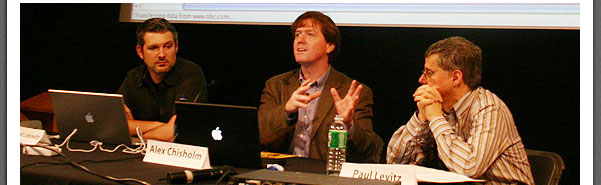
The Convergence Culture Consortium holds at least one major event every academic year, designed to bring together leaders from both academia and industry. Each event provides attendees with insights, opportunities, intellectual stimulation and a whole lot of fun.
Below you'll find links to new events and archived events. C3 also invites interested parties to attend public events presented by CMS and the MIT Communications Forum. For more information on CMS and Communications Forum events, please visit cms.mit.edu/events.
Past Events
Futures of Entertainment 2
November 16-17, 2007 Bartos Auditorium, MIT
The logics of convergence culture are quickly becoming
ubiquitous within the media world. Audiences are being encouraged to
participate in a wider range of sites. Transmedia principals are being
adopted by content producers in a broad range of fields. 'Engagement'
is being discussed as crucial to measurements of success. Futures
of Entertainment 2 brings together key industry players who
are shaping these new directions in our culture with academics
exploring their implications. This year's conference will consider
developments in advertising, cult media, metrics, measurement, and
accounting for audiences, cultural labor and audience relations, and
mobile platform development.
Scheduled speakers include:
- Jesse Alexander (Heroes)
- Danny Bilson (The Rocketeer)
- Marc Davis (Yahoo!)
- Mark Deuze (Indiana U)
- Tina Wells (Buzz Marketing Group)
The official conference site is available at http://convergenceculture.org/futuresofentertainment.
Convergence 2007: Collaboration 2.0
April 21, 2007 MIT
Collaboration marks Convergence
Culture. The working together of platforms, industries, audiences,
producers, and consumers is a hallmark of the current media
environment. Hosted by the Convergence Culture Consortium at MIT, Collaboration
2.0 explored models of collaboration, co-creation and the
opportunities for brand revival within convergence culture.
This event brought together researchers from both national and international universities to explore best practice models of mobilizing user-generated content and activating audiences as co-creators, to look at the impact active audiences can have on brands and consider new modes for engaging the audience. The event provided an opportunity for members of the Consortium to talk to C3 researchers, academics and other consortium members about the reshaping of the industry.
Speakers at Collaboration 2.0 included:
- Jean Burgess (Queensland University of Technology)
- John Banks (Queensland University of Technology)
- Kevin Sandler (University of Arizona)
- Robert Kozinets (York University)
For more information, please see our weblog entries from the conference:
- Collaboration 2.0: An Introduction
- Collaboration 2.0: Sam Ford and Soap Operas
- Collaboration 2.0: Henry Jenkins and Media Violence
- Collaboration 2.0: John Banks and Developer/Gamer Relationships
- Collaboration 2.0: Jean Burgess and Vernacular Creativity
- Collaboration 2.0: Kevin Sandler and Scooby Doo
- Collaboration 2.0: Robert Kozinets and Star Trek
- Collaboration 2.0: Ivan Askwith and TV's Terminology for User Engagement
Futures of Entertainment
November 17-18, 2006 Bartos Auditorium, MIT
As
advertisers look for new ways to engage audiences, content creators
search for new audiences, and audiences quest for new ways to connect
with culture, the nature of what counts as "entertainment" is rapidly
changing. We are seeing the blurring of aesthetic and technological
distinctions between media platforms, of "advertising" and "content"
and of "creator" and "consumer." Futures of Entertainment
brings together key industry leaders who are shaping these new
directions in our culture.
The inaugural Futures of Entertainment conference considered developments such as user-generated content, transmedia storytelling, the rise of mobile media and the emergence of social networking. Speakers included:
- Caterina Fake (Flickr)
- Michael Lebowitz (Big Spaceship)
- Paul Levitz (DC Comics)
- Diane Nelson (Warner Bros. Fan Relations)
- John Lester (Linden Lab)
- Robert Tercek (Multimedia Networks)
For more information, please visit the archived conference site at www.convergenceculture.org/futuresofentertainment/2006.
Convergence 2006: THERE IS NO BOX
April 2006 MIT Museum and Sloan Business School
With Henry Jenkins playing the
role of the spoon-bending child from The Matrix, Convergence
2006: THERE IS NO BOX in April 2006 got off to a bang. In a mixture
of public and private sessions conferees discussed topics including
media history, brand loyalty, fan productivity, patterns of multimedia
use, online community formation, the global television trade, marketing
in video games and the experience economy.
Drawing together consortium members, faculty, and affiliated researchers, the retreat served as a fitting end to the first year of C3, providing an opportunity for the diversity of perspectives the consortium draws upon to be appreciated. Simultaneously, the retreat began to map out the research trajectory for the second year of the endeavor. An overview of presentations from the event is available on an archived entry on our Weblog.


